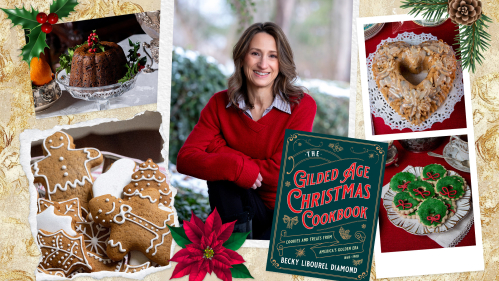
Librarian Becky Libourel Diamond highlights historic menus and recipes updated for modern kitchens in her latest work
Rutgers librarian and food writer Becky Libourel Diamond is bringing back sugar plums from beloved holiday stories while highlighting other more familiar favorites in the Gilded Age Christmas Cookbook: Cookies and Treats from America's Golden Era.
This is Diamond’s second cookbook focusing on recipes from the Gilded Age, the period from approximately 1870-1900 that has become known for its rapid innovation, economic growth and stark inequality.
Diamond features 38 recipes collected from the era’s newspapers, magazines, and cookbooks and a few passed down from her family, such as scotch shortbread, raisin penuche and soft molasses cookies.
She talked to Rutgers Today about the inspiration behind her newest cookbook, which melds stories of celebrities from then, including the Vanderbilts and Astors, with historic menus and recipes updated for modern kitchens.
Why do you continue to explore this period?
So much of our history can be learned through food, and it’s my goal to both educate and entertain readers through my books. The Gilded Age is particularly fascinating to me because it was a time of explosive innovation and technology, including within the food industry and inside American kitchens. The chemical leavenings like baking powder and soda, the rotary eggbeater, canned goods, better refrigeration and improvements in chocolate processing were all introduced then.
Why did you decide to focus on holiday recipes?
I wanted to expand upon my Gilded Age culinary research, highlighting the many holiday recipes and traditions that become mainstream during that era. It was an idea that had been brewing for a number of years—ever since I started to focus on the 19th century as a timeframe for historic food. Just like the previous book, I have combined history with recipes from the era, which have all been updated for today’s kitchens, so they are all accessible to modern cooks. Recipe headers and sidebars provide insight about the origins of holiday foods and celebrations. I actually would like to do a trilogy, with the final book on Gilded Age teas and parties.
Are there many recipes or traditions that people will recognize?
In doing the research for the book, I was thrilled to discover that the Gilded Age was the timeframe when Christmas was really evolving into how we celebrate it today, with the idea of gift giving, Santa Claus, the Christmas tree, Christmas cards and Hanukkah celebrations all becoming mainstream. People from countries all over the world brought their various customs with them to America. As a result, Christmas celebrations in the United States ended up being a mix of different traditions from several nations. This included baking lots of holiday treats like the gingerbread (one of the earliest Christmas cookies). Today, gingerbread men or spice cookies are still often associated with Christmas. There are also butter and sugar cookies that will look familiar such as shortbread and frosted Christmas cookies, and recipes people may have heard of but might not know how to make such as sugar plums and plum pudding.
Are there some ingredients that were common but fell out of favor that you think could become popular again?
Many of the recipes use more spices, and perhaps some not commonly associated with baked goods today, such as caraway, cardamom, nutmeg, mace, allspice, ginger, cloves, cinnamon, and even red pepper. This was common among the various spice cookies at the time, which were traditional Christmas treats brought to America by European immigrants. Rosewater, lemon essence and orange flower water -- sometimes called orange blossom water -- were also used quite a bit and are included in a few of my recipes. They add a delightful delicate layer of flavor, especially when paired with spices like cinnamon or nutmeg, and I encourage folks to try them. They can be found online or in the international section of supermarkets. Citron was another common ingredient in many Gilded Age Christmas desserts and is included in a few recipes in the cookbook. Dried fruit and nuts were another typical addition to holiday recipes and form the backbone of many treats popular at the time, including sugar plums and plum pudding.
What is your favorite recipe in the cookbook? What do you want people to take away from reading it?
I love the ginger ice cream; ginger just evokes Christmas for me. Ice cream was becoming more available due to improvements in refrigeration and the invention of the ice cream maker for home use. My other favorite recipe is chocolate wine. At the beginning of the Gilded Age, chocolate was still mostly consumed as a drinking beverage and warming it with some sherry, or other fortified wine, sugar and a little cornstarch to thicken is a delicious, festive drink. It is also fantastic over ice cream! The Gilded Age Christmas Cookbook bridges the past and present, bringing back sugar plums and other confections not typically found in modern cookbooks, while revisiting some beloved favorites. Whisking readers back in time to this fanciful era, I hope the treats will delight the inner child in everyone.
Christmas Cake Recipe
Courtesy of Becky Libourel Diamond
Christmas cake began appearing in the mid-nineteenth century. Essentially, it was a more cake-like version of plum pudding, omitting alcohol as an ingredient to make it more suitable for family gatherings. By the Gilded Age, there were several variations. Although most featured lemon as a flavoring in some form, some were baked in the fashion of a yellow cake, rich with butter, sugar, eggs, and cream, and others were laden with lots of dried fruit and maybe some nuts and/or anise seed. Then there were versions that were in between these two styles, such as the recipe featured below. Some cookbooks recommended making small Christmas cakes that could be decorated with “fanciful designs,” such as a flower (made from a candied cherry as the center and split almonds as the petals) or a turtle (crafted using a large raisin as the center and some whole cloves as the head and feet).

Instructions (serves 12)
- 2 sticks (1 cup) butter, softened
- 1 cup sugar
- 3 eggs
- 1 teaspoon lemon extract
- 3 cups flour
- 1 teaspoon cinnamon
- 1/2 teaspoon nutmeg
- 2 teaspoons baking powder
- 1 cup raisins
- 1/2 cup dried currants
- 1/4 cup diced candied citron*
- 1 cup milk
Preheat oven to 350°F. Grease and flour a 9- to 10-inch Bundt pan (or two 6-inch ones).
Cream the butter and sugar in a bowl until a pale yellow color, about 1–2 minutes. Add the eggs one at a time, continuing to beat until well mixed, then add lemon extract. Sift the flour with the cinnamon, nutmeg, and baking powder in a separate bowl, then stir in the dried fruit. Gradually add to the butter, sugar, and egg mixture, alternating with the milk. Mix until thoroughly combined.
Pour batter into the Bundt pan(s). Place on the oven’s center rack and bake for about 50–60 minutes for a full-sized pan or 35–40 minutes for two smaller ones, or until a toothpick inserted in the center comes out clean. Place pan on a wire rack to cool, about 10–20 minutes, then place another wire rack over the base of the cake and invert the pan to release the cake. You may need to run a knife along the pan edges and/or tap the sides.
*Diced candied citron can be found in the baking section of grocery stores or online. Paradise is a brand commonly used.
When cool, drizzle with Lemon Vanilla Glaze.
LEMON VANILLA GLAZE
- 1 cup confectioners’ sugar
- 2 tablespoons lemon juice
- 1 teaspoon vanilla
Place all ingredients in a small bowl and mix with a wire whisk until combined.
Drizzle on the cake with a spoon. If you want an extra punch, use a toothpick or wooden skewer to poke several holes in the top of the cake before applying the glaze; some of the sugary glaze will infuse the cake with moisture and sweetness.
This cake is best served the day it is made. Refrigerate any leftover cake and heat in the microwave for 30–60 seconds before serving, if desired.


