Two Rutgers Professors Earn Prestigious Sloan Research Fellowships
The award recognizes outstanding early-career faculty who have the potential to revolutionize their fields of study
A Rutgers chemist working to develop sustainable fuels, medicines and materials and a mathematician probing mysteries of the universe were awarded the Sloan Research Fellowship, one of the most prestigious honors for early-career researchers in science.
The fellowship, which includes a two-year $75,000 award, is among the most competitive and distinguished available to early career scholars. Many recipients go on to receive some of the highest honors in their fields, including 58 who went on to receive the Noble prize.
The two Rutgers scholars—Maxime Van de Moortel from Rutgers-New Brunswick and Demyan Prokopchuk from Rutgers-Newark—are among 126 young scientists from across the U.S. and Canada selected this year.
Since the first Sloan Research Fellowships were awarded in 1955, 65 Rutgers faculty received the award. The 2026 fellows were announced Feb. 17.
Demyan Prokopchuk
Department of Chemistry
School of Arts and Sciences, Rutgers–Newark
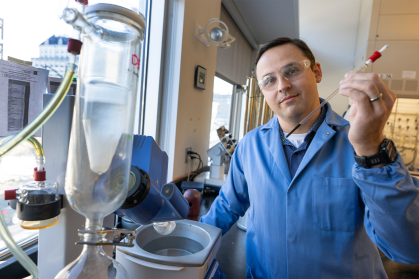
Demyan Prokopchuk’s research lab designs catalysts that leverage reactive carbon-hydrogen bonds and high-energy electrons to help develop sustainable fuels, medicines and materials.
“So many scientists that I deeply respect have received this award, so I felt a mix of shock and honor when I heard the news,” said Prokopchuk. “It’s validation that we’re doing science that interests other people and has the potential for real-world impact.”
In 2025 Prokopchuk, together with colleagues at the Pacific Northwest National Laboratory won a $660K 3-year grant from the U.S. Department of Energy to study how to use high-energy electrons to activate small molecules such as carbon dioxide to transform greenhouse gases into chemicals useful for sustainable industrial applications.
He was also named a Rising Star in Organic and Inorganic Chemistry by the American Chemical Society journal ACS Organic and Inorganic Au in 2025 and has received similar accolades and honors from other prestigious journals over the last two years.
This is also second time Prokopchuk was recognized as a promising young scientist. In December 2024, he received the National Science Foundation Early CAREER Award, a 5-year research grant that supports early-career faculty who have the potential to serve as academic role models in research and education and to lead advances in the mission of their department or organization.
“Over the last two years, Demyan has amassed an array of honors and awards recognizing his creativity and excellence,” said SASN Dean Jacqueline Mattis. “This Alfred P. Sloan Research Award—an award that recognizes early career scholars who are field-changing innovators—is the perfect articulation of his status as a rising star in his field. We could not be more excited for him and for the extraordinary work he is doing.”
Maxime Van de Moortel
Department of Mathematics
School of Arts and Sciences, Rutgers–New Brunswick
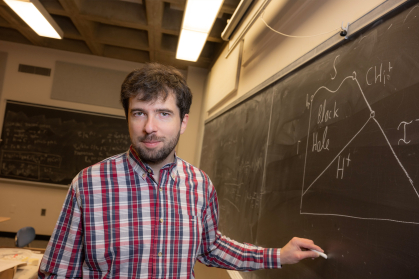
For Maxime Van de Moortel, mathematics is more than an abstract pursuit. It is a way of traveling to places no spacecraft can reach.
His research explores one of the most extreme environments in the universe: the interior of black holes, where gravity bends space and time beyond everyday intuition.
“I use mathematics to answer big mysteries about the universe; for instance, what happens inside a black hole,” Van de Moortel said. “My results are rigorously proven, but they also defy our common sense about how the world works.”
Black holes may sound like science fiction, he said, but they are real astronomical objects observed throughout the universe. He uses advanced mathematical tools to study their interiors, where gravity becomes so extreme that it creates singularities that challenge general relativity, Einstein’s theory of space and time.
Van de Moortel was nominated for the Sloan Research Fellowship by Christopher Woodward, chair of the Department of Mathematics at Rutgers University–New Brunswick, who praised both his research contributions and his impact as an educator.
Woodward said Van de Moortel has made significant progress on some of the most challenging singularity problems in mathematical relativity, particularly Penrose’s Strong Cosmic Censorship conjecture. “He is also a talented lecturer who explains complex mathematical concepts in clear, accessible terms and has been actively involved in public outreach, encouraging students from a wide range of backgrounds to engage with mathematics.”
“Dr. Van de Moortel embodies the extraordinary talent of our research faculty in pushing the boundaries of human knowledge in ways that make a tremendous difference for our world,” Rutgers–New Brunswick Chancellor Francine Conway said. “His achievements exemplify the Rutgers vision for research in which intellectual ambition, interdisciplinary excellence, and real-world impact drive discovery with purpose.”
One of the central questions guiding Van de Moortel’s work is cosmic censorship, a conjecture proposed by physicist Roger Penrose that asks whether the laws of gravity remain predictable even under the most extreme conditions.
“Black holes put our understanding of general relativity to the ultimate test,” he said. “The goal of my research is to determine whether gravity remains predictable all the way to the heart of a black hole.”
The Sloan Research Fellowship will allow Van de Moortel to devote more time to tackling fundamental problems in General Relativity and to pursue ambitious research directions.
“We’re now at a point where mathematical tools are finally powerful enough to tackle these decades-old mysteries,” he said. “I’m eager to see what we discover as we explore deeper into the interior of black holes.”