James Simon, Who Helped Save the World’s Basil, Receives Highest Honor for His Work

The Rutgers plant biologist was elected to the 2025 Class of the National Academy of Inventors
When basil crops across the United States began collapsing 15 years ago, farmers were desperate. A mysterious strain of downy mildew began wiping out crops with no treatments, no way to stop the disease from spreading and no basil varieties that were resistant to the destructive plant disease.
That’s when James Simon, Rutgers Distinguished Professor in the department of Plant Biology in the School of Environmental and Biological Sciences (SEBS) organized a team that spent more than a decade identifying the pathogen, developing a solution and breeding the first downy-mildew-resistant basil varieties that are now grown worldwide.
“One year after another the disease, which was first identified in Florida and came up to New Jersey, did significant damage to commercial farmers,” Simon said. “With my colleagues, it took us over 10 years of intense work, for which I am very proud, to have developed and released the first basil downy-mildew-resistant varieties that have been grown all over the world.”
The achievement remains a celebrated agricultural breakthrough. As a result of his cutting-edge plant breeding research on basil and many other food crops and discoveries that impact human health, Simon was elected to the 2025 class of the National Academy of Inventors (NAI), one of the highest honors for academic innovators.
“Jim’s work has had a significant impact on agriculture, particularly for farmers, helping them overcome challenges and sustain their livelihoods. We are proud of this achievement and look forward to continuing to support groundbreaking research like Jim's across Rutgers through our Technology Transfer team,” said Michael E. Zwick, Rutgers senior vice president for research.
Simon said when he learned he was being included in the academy’s 2025 list he felt “shock and awe.”
“I really thought they had made a mistake,” he said. “It felt like walking on clouds. I’m proud, of course, but everything I’ve done has been with incredible colleagues and students. This honor belongs to all of us.”
Simon said one of his greatest contributions is team building – bringing together talented researchers with diverse expertise in fields such as chemistry, pharmacy, agribusiness, genetics, entomology, anthropology, engineering, microbiology, climate modeling and more.
“Innovation takes years of work by dedicated teams of people with a shared goal of solving real-world problems,” he said.
Simon is one of 169 U.S. inventors elected to the 2025 Class of Fellows and the 14th Rutgers professor to be named and elected to the prestigious organization. He will be formally inducted during a ceremony in June in Los Angeles.
“NAI fellows are a driving force within the innovation ecosystem, and their contribution across scientific disciplines are shaping the future of the world,” said Paul R. Sandberg, president of the NAI.
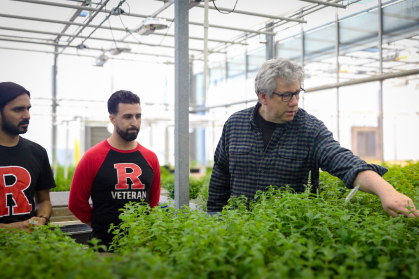
Simon, director of Rutgers New Use Agriculture and Natural Plant Products Program, has built his career exploring how plants can improve human health, nutrition, and provide economic stability to communities. Although he holds more than 20 patents, with more pending, he says he never pursued discoveries simply with intellectual property in mind.
“For the first 20 years of my career, filing for patents never crossed my mind,” Simon said. “I was driven simply to help communities, solve problems, following the science wherever it led and that resulted in many exciting surprise discoveries.”
Simon’s goal is to develop new plant varieties, strengthen food systems and identify natural products that can address serious health issues. His research includes breeding culinary herbs and medicinal plants, identifying natural compounds that treat inflammation, stroke risk, diabetes, anxiety, depression, and addiction, and discovering natural insect repellents that includes a catnip-based compound that is safe and effective.
Beyond his laboratory and greenhouse work, Simon is widely recognized for advancing food security across Sub-Saharan Africa. In Kenya, his team has helped develop innovative urban “sack gardens” that allow families living in crowded neighborhoods of Nairobi and Eldoret to grow fresh produce. He and his team are also developing and testing whether iron-rich amaranth – a drought-tolerant plant with edible leaves and tiny gluten-free seeds -- can improve human health.
A member of the Rutgers Center for African Studies, Simon’s fieldwork spans Ghana, Kenya, Liberia, Madagascar, Namibia, Rwanda, Senegal, Tanzania, and Zambia, and currently the Federated States of Micronesia. Internationally, he is invited to collaborate with local scientists, farmers, traditional leaders and non-governmental agencies to support community-led food system development based on culturally preferred crops and their indigenous plants.
His early research, he said, focused on drought and heat tolerant plants that could support communities farming in eroded or nutrient-poor soils. Unusual at the time because most of his peers were focused on crops such as corn or soy. Simon said his research set the foundation for his lifelong focus on studying under-recognized plants that few other scientists were exploring.
Simon and his team have not only developed plant varieties resistant to diseases but have also created plants that can better withstand cold temperatures. Simon’s team is now breeding nutrient-dense vegetables, that surveys indicate are preferred by Latino, Africa and South East Asian communities. These types of specialty crops support New Jersey farmer livelihoods while providing culturally desired vegetables for New Jersey residents.
The NAI recognition, Simon said, makes him want to continue innovating. His team is advancing new natural pharmaceuticals, next-generation insect repellents, new generations of Thai and lemon basils, culturally preferred nutrient-rich crops, baby greens with new flavors and aromas, and vegetables that can withstand extreme heat and drought.
Sharing this critical information to farmers, students and the public is important to Simon, who said his lab’s scientific work and resulting disease resistant plants have little impact if the public doesn’t know about it. He co-founded Rutgers Immersive Learning through Science Storytelling Lab, recently recognized by a New Jersey State Senate resolution for increasing public trust in science.
“I feel incredibly humbled and very fortunate,” Simon said. “This National Academy of Inventors honor inspires me to keep pushing the science forward. There is still so much to learn and so much more exciting work to be done.”