Rutgers Health Administrator Shares Her Own Breast Cancer Story
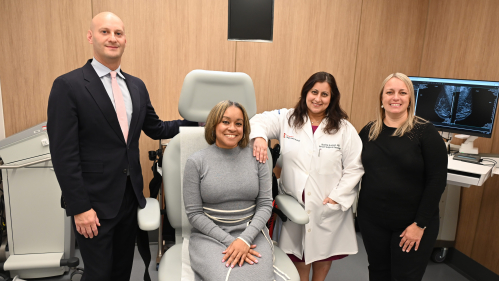
For more than two decades Lauren Marshall, manager of communications and special events at Robert Wood Johnson Medical School, marked Breast Cancer Awareness Month with a ritual: painting her nails bright pink in memory of her best friend Fatima.
It’s been her mission to inspire others to get screened for breast cancer, and this simple splash of color sparked hundreds of conversations about early detection. When she showed off her pink nails this year, however, Marshall had a new breast cancer story to share—her own.
I didn’t feel anything; it was that tiny. There was no reason for me to believe the biopsy wasn’t going to come back normal.
Lauren Marshall
Prior to the cancer diagnosis, Marshall was an existing patient who had been vigilant about screenings since age 35, driven by the loss of Fatima and another close friend. Over the years, she experienced a few atypical mammograms that led to additional testing and twice-yearly monitoring under the guidance of Elizabeth Berg, breast surgical oncology nurse practitioner at Rutgers Cancer Institute, the state’s only National Cancer Institute-designated Comprehensive Cancer Center together with RWJBarnabas Health. But, in 2024, a screening mammogram raised an alarm.
“Lauren had a more detailed diagnostic mammogram and ultrasound that confirmed that the asymmetry on the left side was normal tissue,” Berg explains. “However, there was a new tiny mass in her right breast with characteristics highly concerning for cancer.”
An expedited biopsy was performed. Marshall was traveling alone a week later when the results appeared in her patient portal. Initially, she resisted opening them, wanting to wait until her appointment with a surgical oncologist. But the night before the appointment, she viewed the results with her husband. The word “malignant” was printed in bold capital letters.
“I didn’t feel anything; it was that tiny,” recalls Marshall, who lives in Piscataway. “There was no reason for me to believe the biopsy wasn’t going to come back normal.”
At her appointment with Shicha Kumar, a surgical oncologist at Rutgers Cancer Institute and RWJBarnabas Health, and an associate professor of surgery at RWJMS, Marshall’s anxiety was palpable—her normally low blood pressure had spiked. But Kumar’s calm demeanor and compassionate approach immediately eased her fears. She pulled out paper and drew diagrams to explain the diagnosis: invasive ductal carcinoma, the most common type of breast cancer. The tumor was small and had not spread. With each reassuring detail, Kumar added a smiley face to the paper—a gesture Marshall would never forget.
“Drawing things out helps patients conceptualize the reality of their diagnoses,” Kumar says. “I explain what the imaging and biopsy revealed, the specific features of each patient’s cancer, its stage and cure rate, and lastly, the treatment options.”
While I do prioritize breast conservation, every patient is different. This is where shared decision-making is important. It’s really about what makes the most sense for that patient, especially if the survival rate would be the same with either option.
Shicha Kumar
Surgical Oncologist, Rutgers Cancer Institute and RWJBarnabas Health
In Marshall’s case, the cancer was stage 1, carrying a cure rate of 90% to 95%. Kumar recommended a lumpectomy and believed Marshall would likely not need chemotherapy or radiation with this conservative approach. But after years of thinking about what she’d do if faced with a breast cancer diagnosis, Marshall felt strongly about pursuing a double mastectomy.
“I just didn’t want to worry about this anymore,” she says. “I was scared, but not emotional because my breasts didn’t define who I am. I saw it as a short-term sacrifice for long-term peace of mind. But honestly, without the love and support of my husband, Troy, and our kids, Colby and Troi-Elizabeth, it would have been a much tougher decision.”
“While I do prioritize breast conservation, every patient is different. This is where shared decision-making is important,” Kumar says about Marshall’s decision. “It’s really about what makes the most sense for that patient, especially if the survival rate would be the same with either option.”
Marshall met with Jeremy C. Sinkin, a plastic surgeon at Rutgers Health and Robert Wood Johnson University Hospital, an RWJBarnabas Health facility, and an associate professor of surgery at RWJMS, who explained Marshall’s options for reconstruction.
“There are several options for breast reconstruction; it’s never a one-size-fits-all approach,” says Sinkin. “It’s important to talk with patients about their expectations, priorities, and preferences to determine what will work best for them.”
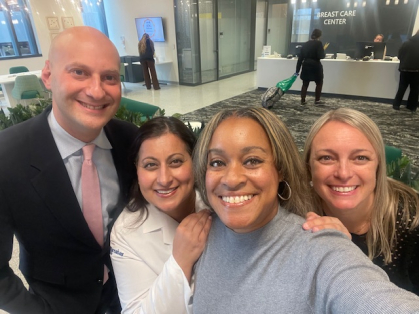
Last December, Kumar and a multidisciplinary team performed a nipple-sparing double mastectomy, removing Marshall’s lymph nodes and most of her breast tissue. During the eight-hour surgery, Sinkin placed expanders in the breasts to prepare them for future reconstruction.
In April, Marshall underwent breast reconstruction surgery, opting for a surgical procedure called deep inferior epigastric perforator (DIEP) flap, which uses tissue and blood vessels from the abdomen to reconstruct the breasts. During the complex procedure, Sinkin and Richard L. Agag, professor and chief of the Division of Plastic and Reconstructive Surgery at RWJMS and chief of Plastic and Reconstructive Surgery at RWJUH, removed the expanders and transferred tissue from Marshall’s abdomen to recreate her breasts. A microscope was used to connect blood vessels from the transplanted tissue with vessels in the chest wall. The procedure requires several days of hospital monitoring to ensure proper blood and oxygen flow in the transplanted tissues.
Now Marshall is back to work at the medical school.
“I feel good,” she said. “I’m happy with my decision. I had great confidence in my team, and everything just fell into place.”
A deeply spiritual person, Marshall spent her recovery reading, praying, and thinking about the friends she lost to breast cancer. She’s determined not to take her survival for granted.
“I made a conscious decision that I did not want to come out of this the same,” she said. “I want to be ready to do whatever it is that God wants me to do with this gift.”
Now when people compliment her pink nails, she still shares Fatima’s story—and also her own. She emphasizes the power of early detection and the advances in screening technology that saved her life.
“It was just a screening mammogram,” she said. “And it detected this tiny tumor. That technology is the reason I’m here.”


