Rutgers Class of 2030 Is Ready to Change the World

Undergraduates are entering Rutgers as the university deepens its commitment to making college accessible and affordable
The incoming Rutgers class of 2030 is one of the most academically competitive in university history—made up of students determined to overcome obstacles, serve their communities, and turn ambition into opportunities to help others.
Their paths to Rutgers are as varied as their goals: A blind transfer student who plans to study social work and one day open a soup kitchen, a pre-engineering student who will balance his studies at Rutgers–Camden with playing vibraphone in the Marching Scarlet Knights in New Brunswick, and a student-athlete pursuing her academic ambitions while competing in cross country and track and field.
Some have already found ways to make a difference in their communities, like the incoming student who has participated in Rutgers Future Scholars since seventh grade and created a nonprofit hoping to address alcoholism in the New Brunswick community, and an Honors College student who helped build a school in Southeast Asia and said he chose Rutgers for its affordability. Others, including a first-generation college student who earned honor roll recognition in high school while working part-time to help support her family, show how the Educational Opportunity Fund (EOF) is helping low-income students succeed.
Their stories reflect an incoming class shaped by resilience, creativity, service, and ambition. They are entering Rutgers as the university deepens its commitment to making a college education accessible and affordable while supporting students’ academic journeys. More than 58% of the incoming class received Rutgers institutional grants and scholarships—aid which includes merit-based scholarships and need-based tuition assistance for students from families earning less than $65,000 annually and are not loans. Some of these students also received Federal Pell Grants and New Jersey Tuition Assistance Grants, as well as Education Opportunity (EOF) support, which students must apply for separately.
“A talented and inspiring group of students is getting set to pursue their goals at Rutgers, and we know it isn’t enough for us to simply open the door,” Rutgers President William F. Tate IV said. “More than just providing access, we are committed to offer the financial, academic, and personal support they may need to stay on the path to a degree and ultimately to experience the full value of a Rutgers education.”
Ryan Kim
Rutgers Business School
Rutgers–New Brunswick Honors College
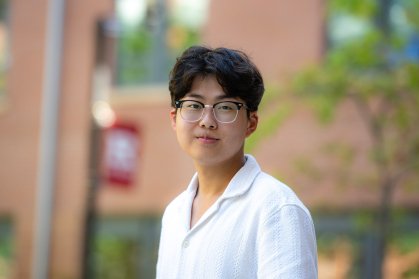
Ryan Kim is unafraid to tackle seemingly big problems—whether it be near his Fort Lee, N.J., home or halfway around the world.
“The only way you can change something is to put the work in,” said Kim, an Honors College student majoring in finance at Rutgers Business School. “The hardest thing to do is to start. Once you start and keep it going, you’ll realize how doable it is.”
Kim is 18 but has already worked to open an elementary school in Laos in Southeast Asia; started a nonprofit called STEM4All that provides free and fun instructional sessions to middle-schoolers; and build functional $30 computers to bring affordable technology to others.
He was just 12 years old when he learned about lack of access to the educational system in Laos and its high dropout rates.
“It was really heartbreaking for me and my sisters to hear,” said Kim, who is the youngest of three. “That’s when we’re like, ‘Let’s try to do something,’ and we did.”
With help through community fundraisers, corporate sponsorships, and Kim’s church, where his father is a pastor, the siblings opened a three-classroom school in a rural area of the capital, Vientiane, in 2021 to serve 30 students. The kindergarten-through-eighth-grade school has now expanded to 20 classrooms with 10 teachers and 230 students.
“Whenever there’s a problem that is very dear to us, we just try to solve it,” said Kim, who finds guidance and inspiration from his sisters, Jian, 26, and Sharon, 21.
As the child of a pastor, service to the community had always been part of Kim’s upbringing. He remembers distributing meals to the needy when he was 5 or 6. At the time, he would hand out the sandwiches without knowing why.
“I didn’t understand why we were helping so much when we also didn’t have a lot,” Kim said. “Once I got to the age where I was talking to the people we were helping, heard their stories, the struggles they went through, why they were in the positions that they were in, then you realize, this is why you’re helping. We can do our part to help no matter what our own circumstance.”
He comes to Rutgers with 36 college credits already under his belt and is poised to complete his degree in three years. He chose Rutgers for its affordability, location, reputation, and access to the state’s Educational Opportunity Fund (EOF), which provides financial assistance to qualifying students.
“Through EOF and their financial support, I’m able to be covered pretty well, so affordability was definitely one reason I chose Rutgers,” he said.
Scholarships made it possible for Kim to attend educational summer bootcamps, like Johns Hopkins University’s Center for Talented Youth for academically advanced and gifted students; or LaunchX, a hands-on entrepreneurship program held at the University of California, Berkeley; and University of Pennsylvania’s Management & Technology Summer Institute, a rigorous college-level program for high school students.
“All these programs have introduced me to incredibly talented students who opened my eyes to the possibility of what can be done,” Kim said. “If I wasn’t exposed to these students, I wouldn’t know what I was capable of doing at that age.”
Ciara Camarena
School of Arts and Sciences
Rutgers–New Brunswick

Coming to Rutgers–New Brunswick as a first-generation college student is the latest milestone for Ciara Camarena in a life shaped by hard work, independence, and a determination to create her own opportunities.
Camarena, 18, grew up in Montvale after moving from the Bronx when she was nine. Her parents emigrated from the Dominican Republic in search of greater educational opportunities for Camarena and her brother. Their example has been a source of motivation.
“I always knew I had to work hard because I knew my parents worked harder,” said Camarena, a graduate of Pascack Hills High School.
Camarena demonstrated that work ethic throughout high school, earning honor-roll grades while managing responsibilities at home, extracurricular activities, and working part time. She played several sports, joined the Latino and Hispanic Culture Club, and mentored incoming freshmen as a peer leader.
She is most proud of saving enough money to purchase her own car with cash.
“It’s just a sign of the independence I built myself,” she said.
Now, as she becomes the first in her family to attend college, Camarena is receiving support through Rutgers’ Educational Opportunity Fund (EOF), a state-funded program designed to expand college access and provide financial assistance, academic support and counseling to students from educationally and economically disadvantaged backgrounds.
This support is particularly meaningful as she navigates a university system that is new to her family. She said EOF counselors helped her make sense of everything from financial aid to unfamiliar university websites and requirements.
“They’re just really helping me through anything I need,” Camarena said. “They answer any questions and clear up confusions right away.”
Camarena enters Rutgers undecided about her major, but wants to learn more about her grandfather’s international business that exports chocolate from the Dominican Republic to the United States and Europe. She hopes college will give her the opportunity to explore that interest while discovering new possibilities.
For now, she is eager to live on campus, meet new people, and take advantage of the guidance EOF and Rutgers can provide as she finds her path.
“I want to really love what I do for the rest of my life,” she said.
Jake Berardinelli
School of Arts and Sciences
Rutgers–Camden
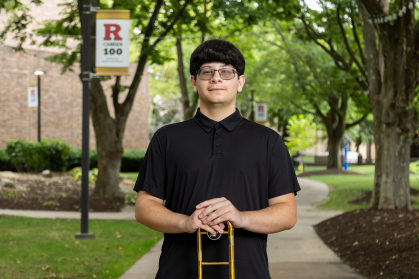
Getting to marching band practice usually means walking across a college campus. For incoming Rutgers-Camden student Jake Berardinelli it will mean getting in the car and driving almost 60 miles.
Berardinelli, 17, of Lincroft, will begin his first year as a pre-engineering student at Rutgers-Camden this fall. But three afternoons a week he plans to make the roughly 80-minute drive to New Brunswick to play vibraphone with the Rutgers University Marching Scarlet Knights.
It’s an unusual college routine but one that will allow the Middletown High School South graduate to pursue two interests that have become important parts of his life: engineering and music.
As a child he took piano lessons. When he needed an elective in sixth grade, he chose band. After telling his band director about his piano experience she steered him toward the glockenspiel.
“It’s basically just a piano you hit with sticks,” Berardinelli said.
By high school, he had moved to the vibraphone, a much larger metal keyboard percussion instrument whose pedal allows musicians to sustain notes, and he had also learned to play the trombone.
Continuing with marching band was important enough that Berardinelli built his Rutgers-Camden academic schedule around rehearsals in New Brunswick. Most of his heavier class days are Tuesdays and Thursdays, leaving Monday, Wednesday and Friday afternoons available for the commute. Saturdays during the fall will mean football games or marching band competitions.
Rutgers-Camden offered Berardinelli compelling reasons to make Camden his academic home. A scholarship and invitation to the Honors College helped draw him to the campus, where he plans to pursue pre-engineering with an eye toward computer engineering.
That interest runs in the family. His father began his career as an electrical engineer while his mother works in information technology at Rutgers-New Brunswick.
“I like working with computers,” Berardinelli said. “It’s always been just a fascinating subject to me.”
Kimberly Morales Herrera
Rutgers School of Nursing
Rutgers Health

For Kimberly Morales Herrera, becoming a student at Rutgers School of Nursing represents more than the beginning of college. It is the culmination of a journey that began in seventh grade when she joined Rutgers Future Scholars (RFS) during the uncertainty of the COVID-19 pandemic.
Morales Herrera, 18, initially knew little about RFS—a program for promising first-generation students like herself from Rutgers’ host cities of Newark, New Brunswick, Camden, Piscataway, and Rahway. But she knew her older brother had participated and understood that the promise of free tuition for RFS students could make college possible for her family.
“My parents work long hours,” Morales Herrera said, who grew up in New Brunswick. “Being first generation, it was kind of a big struggle to figure out how I would get to college and how I would continue with my education.”
RFS became much more than financial assistance. Through summer programs, monthly meetings and networking opportunities, Morales Herrera learned what college would demand and how to build relationships with professors. She also found a community of students with similar ambitions and experiences.
“If it wasn't for those classes that we took, I definitely would not have been prepared for college,” she said.
Morales Herrera, who also receives support through the Educational Opportunity Fund, is working toward a bachelor’s degree in nursing. She became interested in the field while attending a high school with a medical focus. She learned it was a way to combine her interest in health care with human connection, something she believes is equally important.
Through RFS, she took CPR and Stop the Bleed training at Rutgers New Jersey Medical School (NJMS) and simulated patient interactions, which reinforced her interest. She is considering careers in neonatal intensive care nursing or pediatric oncology, where she could advocate for vulnerable patients.
“I feel like it’s very important to have someone who can be there and speak up for people who can’t,” Morales Herrera said.
That instinct has already taken shape outside the classroom. As a high school junior, Morales Herrera founded Orbiting Hope, a nonprofit initiative seeking to connect people affected by alcoholism with resources and support.
Morales Herrera said she was shy growing up, but advocating for others helped her discover her own voice, a lesson she plans to carry into nursing.
“Through speaking up for people,” she said, “I learned how to speak up for myself.”
Kelly Shanklin
School of Environmental and Biological Sciences
Rutgers–New Brunswick Honors College
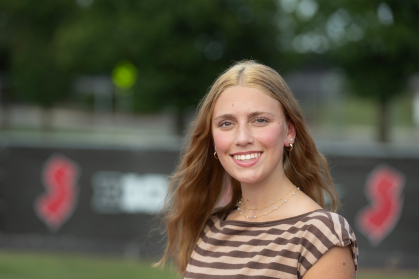
Kelly Shanklin’s road to Rutgers–New Brunswick has been measured in miles and defined by persistence.
The 17-year-old from Clinton Township enters Rutgers–New Brunswick as an Honors College student studying biology on the pre-med track and as a member of the Scarlet Knights women’s cross country and track and field teams.
Shanklin’s curiosity about medicine began during her freshman biology class at North Hunterdon High School.
“I just kind of fell in love with the subject,” she said. “I had a really great teacher who got me very interested in it.”
That same year Shanklin discovered another passion. After playing volleyball in middle school she decided to give cross country a try instead. She quickly emerged as one of New Jersey’s top distance runners.
One of her most memorable early races came on Holmdel Park’s notoriously challenging cross-country course where Shanklin lost a shoe but finished the 5K anyway.
“I got flat tired,” she said. “It was my first time running a cross country 5K, so it was definitely interesting.”
Her resilience would be tested more seriously two years later. Shanklin broke her foot near the end of her junior year cross-country season and underwent surgery the following February.
“There were definitely times when I doubted if I would be able to get back into the shape I once was,” she said. “But I just continued working hard.”
By the end of her senior track season that work paid off. Shanklin surpassed her previous personal best in the mile, a feat that taught her lessons she will carry to Rutgers and hopefully into a career in medicine.
“Cross country and track and field have definitely taught me a lot about grit and persistence,” Shanklin said. “It also showed me how important it is to keep putting in the work even when you’re not seeing the results that you want.”
Rutgers carries a family connection. Her mother is a Rutgers alumna and current doctoral student.
“I’m very excited about this new chapter in my life,” she said. “I get to meet new people, try new things. It’s just an exciting new experience.”
Marlon Temple
School of Arts and Sciences
Rutgers–Newark

After overcoming a lifetime of obstacles to enroll in Rutgers-Newark at the age of 53, Marlon Temple wants to become a port in the storm for others in need.
Following his troubled teenage years, the East Orange resident joined the Navy in the hopes of turning his life around. But less than two years in, he experienced his first of many mental health episodes spurred by then-undiagnosed bipolar disorder. A decades-long cycle ensued: months or years of steady employment upended by bouts of mental illness would land him in a psychiatric hospital and force him to start from scratch.
The years of ups and downs took a toll on his body. During a suicide attempt nearly 10 years ago, Temple, a Type 2 diabetic, overdosed on his insulin, leaving him legally blind. And permanent damage to his kidneys requires three rounds of dialysis a week.
Instead of giving up, Temple chose to stay on the medications he needs to stabilize his mental health and work toward his goal of getting a college degree.
“Every time I asked for help, someone would tell me, ‘It’s not my job,’” said Temple of his experiences seeking public assistance. “I want to be the person who gets it done.”
A transfer student from Essex County Community College, Temple is ready to start his undergraduate degree in social work from Rutgers-Newark School of Arts and Sciences with a minor in nonprofit and philanthropic studies from the School of Public Affairs and Administration.
“The Bible told me all things are possible. That’s how I got through Essex County with a 3.97 GPA,” said Temple, a Federal Pell Grant and New Jersey Tuition Aid Grant recipient, who uses Speak-To-Text and screen reader features on his tablet and phone as well as audio books when studying. “I don’t think Jesus brought me this far to leave me.”
His long-term goal is to earn his master’s degree in social work before opening a one-stop shop for people in need. He wants to create a combination soup kitchen and short-term shelter staffed with nurses and social workers to help connect clients with services that can end their cycles of homelessness, food insecurity, mental and physical health illness. The kind of place that could have helped him all those years ago.
“It isn’t that they can’t do it,’’ Temple said. “It’s about getting them the resources.”


