New book traces perceptual change of salt marshes from wasteland to resource
Where others might see only muck and decay, Rutgers–Newark marine biologist Judith S. Weis sees a rich and promising environment, a boundary between land and water whose harsh conditions create some of the planet’s most enduring inhabitants.
Salt Marshes: A Natural and Unnatural History (Rutgers University Press 2009) is at once Weis’s ode to the ecosystem she fell in love with as a child and a call to action aimed at elected officials, scientists, amateur naturalists … any interested reader who cares for the environment she poetically calls “neither fully land nor fully water.”
The book traces the evolution of perception that is slowly – incrementally, Weis said – changing people’s views of the grasses, insects, birds, mammals, and fish that populate the wetlands and their role in the greater world around them.
“There’s been a gradual transition from thinking of salt marshes as wasteland to thinking of them as a resource,” she said.
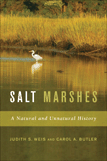
Weis and coauthor Carol A. Butler note that the decision makers ignore the benefits of the salt marshes at their own risk – and society’s. In addition to providing a habitat for endangered species, the wetlands serve as both stabilizers of the shores they border and “nature’s own purification system,” to use Weis’s term.
In locales as diverse as Sri Lanka and Louisiana, marshes (or mangroves, in the case of tropical areas) are a crucial buffer against hurricanes and tsunamis. In regions that depend on the export of seafood, they act as an incubator for commercial species in their youngest, most vulnerable state, Weis said.
The Rutgers academic traces her passion for the terrain to a serendipitous discovery she made when she was a 7-year-old summering on Shelter Island, New York. It was a plain old, garden-variety hermit crab encrusted with algae and barnacles, but it opened the future scientist’s eyes to the possibilities nature carries.
“The fact that there were all those other animals attached to this shell made it a whole walking community,” Weis said, in awe even decades later. “It was not just a hermit crab but this very special entire community. I just thought that was the coolest thing imaginable.”
Fascinated by the biology of the sea, she went on to enroll at Cornell University, studying during summer breaks at the Woods Hole Oceanographic Institution and the Marine Biological Laboratory on Cape Cod and entering a field that at the time was not particularly welcoming to women.
Weis has been researching the salt marshes and mangroves ever since, mostly in New Jersey but also up and down the East Coast from Massachusetts to Florida, and as remotely as Indonesia and Madagascar. She has published more than 200 scientific articles; the Rutgers University Press book is her first opportunity to share her passion with a nonacademic audience, Weis said, and she couldn’t be more excited.
“It’s a fun and fascinating field – I can’t understand why everybody isn’t into it,” she said with a laugh.
The proximity of her campus to New Jersey’s own marshlands makes student field trips a natural. Weis said she’s amazed by the story arc being played out in the nearby Hackensack Meadowlands, long the object of New Jersey jokes and now a model of regeneration.
“If anyone would have told me in the 1970s that we would have ecotours of the Meadowlands, I would have fallen off my chair in laughter, it was such an absurd idea,” said the author, who details the rebirth of the urban wetland in one of her book’s chapters.
“It was a total dump, it stank, and there was nothing to see. So it’s just a miracle to see what’s happened as a result of cleaning up the sewage, closing up the garbage dumps, and having a new focus on conservation.”