A day-long symposium exploring how antibiotics became a game-changer in modern medicine
WHAT: “Antibiotics–Soil’s Microbial Miracles,” a day-long symposium exploring how antibiotics became a game-changer in modern medicine and culminating with the opening of the Waksman Museum at the site of the original Rutgers streptomycin lab.
WHEN: Wed., Dec. 12, at 9 a.m. to 6 p.m. Specific media availability can be arranged.
WHERE: Trayes Hall, Douglass Campus Center, 100 George Street, New Brunswick, N.J.
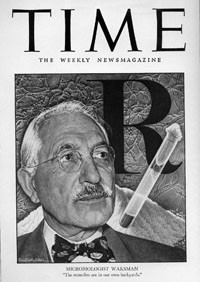
BACKGROUND: Sixty years ago, Selman Waksman was awarded the Nobel Prize in Physiology or Medicine for "ingenious, systematic and successful studies of the soil microbes," which led to the discovery of streptomycin, the first antibiotic effective against tuberculosis as well as the pathogens responsible for cholera, typhoid, bubonic plague (Black Death), relapsing fever, typhoid and tularemia.
Graduate students Albert Schatz and Elizabeth Bugie, along with Waksman, discovered streptomycin in the 1940s while performing research on soil microbes in a basement lab in an administration building, now Martin Hall, on the George H. Cook Campus of Rutgers. As a result of the research on antibiotics by Selman Waksman and others at Rutgers, the American Chemical Society honored the university by designating the lab as a National Historic Chemical Landmark. In addition, the American Society for Microbiology designated Rutgers the birthplace of soil microbiology in the U.S.
Media Contact: Paula Walcott-Quintin
848-932-4204
E-mail: quintin@aesop.rutgers.edu