
Rutgers Is Established (1766)
Originally chartered as Queen's College, Rutgers cemented its roots in American history as one of only nine colonial colleges—and the eighth-oldest college in the country.

Rutgers Honors America's 250th Anniversary
Sol Iustitiae et Occidentem Illustra: The university’s motto, “Sun of righteousness, shine upon the West also,” is today interpreted as a request for the enlightenment of learning to shine equally upon the New World.
Rutgers: Revolutionary From the Start
Established in 1766, Rutgers predates the American Revolution by a decade—and has helped to shape our nation ever since. From the early days of the republic to today, Rutgers students and scholars have contributed discoveries and innovations that have defined American history and our shared culture.
Rutgers History Is American History
America turns 250 years old on July 4, 2026, and Rutgers is deeply intertwined with the story of our nation.
Explore just some of the ways Rutgers has impacted American life throughout the years.
Rutgers Is Established (1766)
Originally chartered as Queen's College, Rutgers cemented its roots in American history as one of only nine colonial colleges—and the eighth-oldest college in the country.

Rutgers Students and Faculty Join the Revolutionary War Effort (1776)
When the Revolutionary War broke out, Rutgers suspended classes and passionate students and faculty took up the cause for the resistance. Meanwhile, a Rutgers student-run literary group held meetings to discuss the "future glory of America."

Scarlet Becomes Rutgers' Official School Color (1869)
Rutgers College students adopted “scarlet” as the iconic school color. A Rutgers tall tale maintains that scarlet was chosen to symbolize the blood of Revolutionary War patriot Nathan Hale, said to have been hanged by the British in 1776 on property owned by the university’s namesake, Colonel Henry Rutgers.

College Football Is Born at Rutgers (1869)
On November 6, 1869, the first intercollegiate football game was played between Rutgers and Princeton in a field on College Avenue. Rutgers wins 6–4.
Over 100 years later, Rutgers bested Princeton again in the first intercollegiate ultimate frisbee game at the same field.

Rutgers’ Research Spearheads Modern Mosquito Control Laws (1912)
Professor J.B. Smith convinced legislature that mosquitos should be dealt with at the state level, demonstrating that one county could be infiltrated by mosquitos from a marsh or swamp of a neighboring county. As a result, New Jersey enacted the 1912 “Smith Laws” —still established today—making Rutgers the birthplace of vector biology and Professor Smith the “father of mosquito control.”

Rutgers Tomato Introduced (1934)
The Rutgers tomato, developed by professor L.G. Schermerhorn, debuted in 1934. Its exceptional flavor led it to become the dominant commercial tomato of the mid-20th century, prized by Campbell’s Soup, Heinz, and others. In particular, New Jersey farmers relied heavily on sales of the Rutgers tomato to Campbell’s in Camden.

Rutgers Men and Women Serve and Die in WWII (1941-1945)
More than 1,700 undergrads and one-third of alumni served during World War II, leading to the deaths of two women and 234 men. First Lady Eleanor Roosevelt visited Rutgers during the effort to promote war bonds to the university community.

Discovery of Tuberculosis Treatment Transforms Modern Medicine (1943)
Rutgers scientist Selman A. Waksman and his graduate students Albert Schatz and Elizabeth Bugie discover streptomycin—the first effective treatment for tuberculosis and the first antimicrobial agent developed after penicillin—coining the term “antibiotic.” For this work, which transformed a once-deadly disease into a treatable condition, Waksman was awarded the Nobel Prize in 1952.

Rutgers Begins to Develop Choice Turfgrass Adorning Iconic American Venues (1962)
If you’ve stood on turfgrass, it was probably invented at Rutgers. Plant biologist C. Reed Funk from the Rutgers College of Agriculture developed turfgrass cultivars that became American staples, found at iconic venues like the White House and Yankee Stadium.

Rutgers Pathologist Helps Warn Millions of Americans About Smoking (1964)
New Jersey Medical School pathologist Dr. Oscar Auerbach helped turn millions away from smoking when his work, which linked cancer to smoking for the first time, was brought to national attention in 1964.

Ruth Bader Ginsburg Helps Chart the Course for Women's Rights (1960s)
In the late 1960’s, Rutgers–Newark students asked their professor, Ruth Bader Ginsburg, to lead a seminar on women and law. While preparing for class, Ginsburg—one of only two women law professors at Rutgers and just a handful in the country—realized the enormity of the legal gap on gender equality and began her lifelong journey pioneering women’s legal rights. She taught at Rutgers for nearly a decade before serving on the U.S. Supreme Court for 27 years.

Institute of Jazz Studies, a World Treasure, Finds Its Home at Rutgers (1965)
The Institute of Jazz Studies found a permanent home at Rutgers University–Newark in 1965 when the world-famous private collection of acclaimed jazz scholar Marshall Stearns moved in. The institute is now considered the largest and most comprehensive library and archive of jazz and jazz-related materials in the world.

Rutgers’ First Gay Rights Student Group Is Founded (1969)
Lionel Cuffie, a Black-rights activist, founded the Student Homophile League, the first gay rights student group formed following that summer’s Stonewall uprising in New York City—and only the second in the nation—to “aid in the breakdown of social and political persecution and discrimination directed against minority groups.”

Rutgers Student Protest Sparks a National Shift in Higher Education (1969)
Rutgers–Newark students took over Conklin Hall to protest the underrepresentation of Black students and faculty, as well as the lack of representation in the curriculum. The movement helped spark nationwide adoption of Black Studies programs and expanded diversity and admissions reforms.

Rutgers' Center for American Women and Politics is Founded (1971)
The Center for American Women and Politics (CAWP) was established at Rutgers' Eagleton Institute of Politics—after its founding directors, Dr. Ruth B. Mandel and Ida F.S. Schmertz, are told that women's political participation is so minimal that it doesn't merit study. CAWP becomes the premier source of data and research chronicling the rise of women in American politics, and today, it offers programming to prepare women and young people to deepen their political engagement.

The “Father” of Cognitive Behavioral Therapy Joins the Rutgers Psychology Department (1972)
Psychologist Arnold Lazarus, the pioneer of cognitive behavioral therapy—popularly known as CBT— joined Rutgers as chair of the psychology department during the 1970s. Here, he developed multimodal behavior therapy, which draws from multiple psychology approaches to tailor treatment to each individual.

A Beloved Children’s Book Hits the Shelves (1972)
Alexander and the Terrible, Horrible, No Good, Very Bad Day, a children’s book authored by alumna Judith Viorst, was published and became an instant classic. In 2014, Disney adapted the still-beloved book into a major motion picture, followed by a 2025 reboot, with an all-new cast, on Disney+ in 2025.

Classic Yacht Rock Hit Written at Rutgers (1972)
The song “Brandy (You’re a Fine Girl)” was the nation’s #1 hit song in 1972. Performed by Looking Glass, a student band formed during their time at Rutgers, the song became a yacht rock American classic.

Rutgers Gets America Recycling (1987)
Rutgers got America to recycle on a grand scale. Just five years after introducing our innovative plastic resin sorter in 1987, the nation went from recycling zero pounds of plastic to over 500 million pounds a year, changing our approach to recycling permanently.

Rutgers’ Report on the Concerns of Gay and Lesbian Students Becomes National Model (1989)
In 1989, the university released a comprehensive study of the gay and lesbian collegiate experience. The first report of its kind, it served as a national model for similar studies for gay and lesbian community members at other American universities.
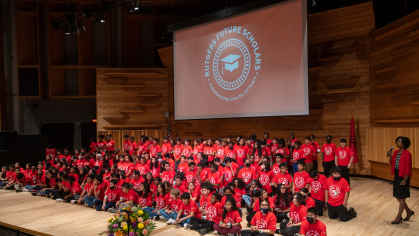
Rutgers' Pre-College Program Launches as a National Model (2008)
Rutgers Future Scholars, a groundbreaking pre-college program that guides academically promising, low-income students in grades 7–12 on the path to a college degree, launches. The program has served over 3,500 first-generation students and counting, offering academic support, leadership seminars, paid internships, and more—with a college graduation rate 25% higher among participants than the national average. Today, the program is replicated at universities across the country.

"America Converges" at Rutgers (2016)
President Barack Obama delivered the commencement address before more than 50,000 guests, graduates, and faculty and staff in honor of Rutgers’ 250th anniversary, noting that at Rutgers, "America Converges Here."

Vegetarian Burger Staple Gets Its Start at Rutgers (2016)
The average American eats around 200 pounds of meat annually and at least one hamburger a week. The Impossible Burger—a meat-free alternative to the iconic ground beef patty—was born at Rutgers in 2016, when the company Impossible Foods came to the Food Innovation Center at Rutgers to turn their idea for a better meatless burger into a reality. Rutgers helped them develop it, produce it to scale, and bring it to market, turning the idea for a better meatless burger into a reality.

Rutgers Develops Game-Changing COVID-19 Test (2020)
Just one month after the COVID-19 emergency began, the Food and Drug Administration granted emergency use authorization to the first saliva-based COVID test developed by Rutgers scientists. The test provided quick and accurate results, eliminating the need for nasal swabs and reducing the use of PPE at a time when these resources were critically low.

Rutgers Leads the Fight Against Cancer (2020s)
Rutgers, in collaboration with RWJ Barnabas Health and international research partners, is pioneering breakthroughs in new and more precise treatments to help the more than 1 in 20 Americans living with a cancer diagnosis.
America 250 Events at Rutgers


