Why Do We Still Mark Groundhog Day?
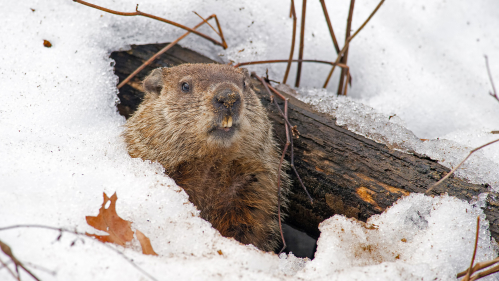
How did Groundhog Day become so ingrained in our culture that it inspired a movie, memes and passing references all year long?
Angus Kress Gillespie, a folklorist and professor emeritus of American studies in the School of Arts and Sciences, explains the roots of the tradition and why he thinks it’s here to stay.
How did the tradition get started?
Groundhog Day in the United States got started by Pennsylvania German settlers in the 18th century. In Germany, people believed that a badger (or hedgehog) could predict weather. The German immigrants in Pennsylvania replaced this familiar animal with something similar—the groundhog. The underlying belief was that you had to look at the weather on Feb. 2, the midpoint between the winter solstice and the spring equinox. If the day was sunny, it meant that there would be a long, difficult winter. A cloudy day would predict an early spring. So, if the groundhog sees his shadow, it means six more weeks of winter. No shadow means an early spring. This became an official event in Punxsutawney, Pennsylvania, in 1887.
Why do we mark the day on Feb. 2?
It’s sort of a relief when we turn the page of our calendar from January to February. We are getting closer to end of winter. But there are other specific reasons for the date. It marks the halfway point between the winter solstice and the spring equinox. It also falls on the Christian holiday of Candlemas, a feast where the clergy blessed candles for the winter, a kind of mid-winter event when everyone was watching the weather.
Why do we put so much stock in the groundhog?
Groundhog Day has grown to be cherished American tradition celebrated nationwide in all 50 states, promoted by television and media. It’s kind of a fun event—a mid-winter break from the grind of daily work and upsetting political news. To be perfectly honest, scientists tell us that the groundhog’s predictions, upon review, are not really accurate. But it’s a cultural touchstone that we look forward to. I like to take full advantage of these calendar customs in my folklore classes at Rutgers. It’s something that students can readily relate to. Yes, we all agree that this is more superstition than science, but it’s a widely held belief. It may be silly, but we have a sense of community just by watching the event on our television sets.
How did this become so ingrained in our culture that it inspired a popular movie, memes, and passing references all year long?
As a folklorist, I am familiar with items of folklore being transformed into popular culture. The old stories are adapted for new audiences through modern media like film and television. The 1993 film Groundhog Day, starring Bill Murray as a cynical television weatherman is perhaps the best example. He is assigned against his will to cover the annual event in Punxsutawney, Pennsylvania. There he becomes trapped in a time loop, and he is forced to relive Feb. 2 repeatedly. The film earned over $105 million, became one of the year’s most profitable films and inspired a 2016 Broadway musical and a 2019 video game.
Do you think we will ever stop observing Groundhog Day or is this tradition here to stay?
Some calendar customs are major and some are minor. Clearly, Valentine’s Day is major, and Groundhog Day is minor. How do we tell the difference between them? A key distinction is the amount of participation. On the one hand, for Valentine’s Day, most of us participate by acknowledging our loved ones. We speak up. We buy flowers. We send cards. On the other hand, for most of us, we only notice Groundhog Day by watching the televised prediction by Punxsutawney Phil. For Groundhog Day, we do not have to do anything at all. Granted, we do not buy presents. We do not send greeting cards. This is a minor event, but I think it is here to stay.