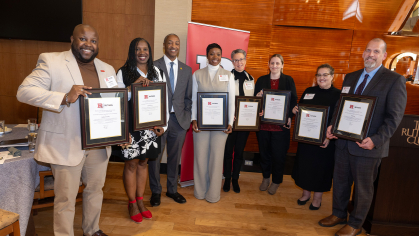
Famed Newark Muralist and Rutgers Grad Invites Public to the 'Drawing Circle'
Before Layqa Nuna Yawar became renowned for his vibrant community-based murals and intricate portrait paintings, he enrolled in a “life-changing” figure drawing class at Rutgers-Newark.
There he discovered his path as an artist, he said, and transferred to Mason Gross School of the Arts at Rutgers-New Brunswick, where he majored in fine art and took figure drawing every semester the course was offered before graduating in 2007.
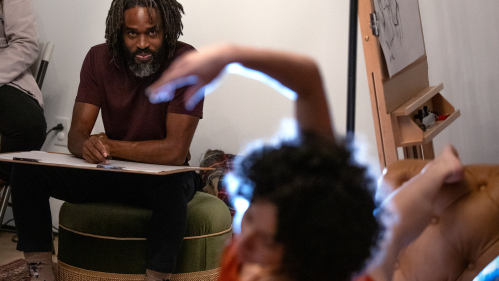
Four years ago, Layqa returned to Rutgers-Newark to pass on the art of figure drawing to a new generation. Only this semester, his course is also open to the public.
“Figure drawing is a practice that is so necessary for any artist,” he said. “I don’t like to say I have talent. My brain works in ways that allow me to capture things with drawing more naturally than others, but it’s a skill we can all have.”
The expanded course, called “Drawing Circle,” features live models and music and is integrated directly into Express Newark’s new exhibit “Drawing Room.”
Forget the sterile white walls and static art of a traditional gallery. “Drawing Room” transforms the Paul Robeson Main Art Gallery into a collaborative canvas that’s constantly evolving.
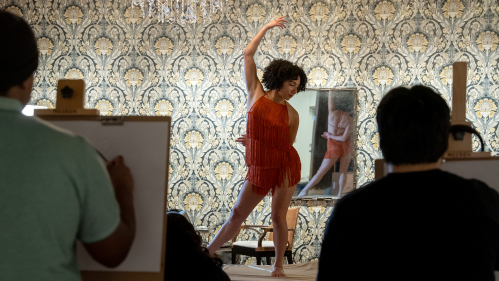
During a recent Thursday class, under the glow of a crystal chandelier and ethereal pulse of a DJ’s soundtrack, two models moved between the exhibit’s Persian rugs and lush jewel-toned furnishings, striking poses for a group of budding students and community artists.
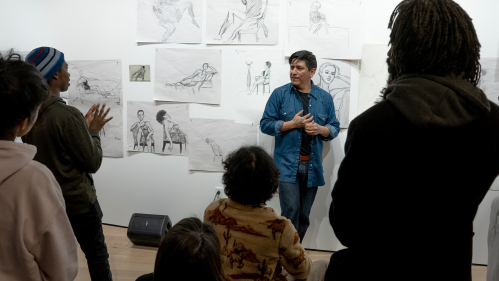
The multi-layered “Drawing Room” exhibit builds on itself week by week, as “Drawing Circle” participants animate the walls of the space with their charcoal sketches during a group critique at the end of each class.
“It is an art installation in the tradition of social sculpture – art that is shaped through collective participation,” said Nick Kline, co-director of Express Newark, Rutgers-Newark’s community art collaborative; associate professor of photography, and program coordinator for the Fine Art Program at Rutgers-Newark. “I liken it to the Fluxus Movement or ‘happenings’ of the 1960s that included multiple performance-based works at same time.”
The class-within-an-exhibit concept takes cues from the elegantly decorated Victorian-era drawing rooms that once served as the social hub of homes.
“Traditionally, drawing rooms were places where people could come together and experiment, try new things in an inclusive space that allowed people to find new voices and new ideas,” said Anthony Alvarez, education director at Express Newark and a lecturer with Rutgers-Newark’s Fine Art Program.
But at their core, “Drawing Room” and “Drawing Circle” were designed in tandem to uphold Express Newark’s mission of melding community and campus through the arts. While the class is open only to enrolled Rutgers-Newark students on Tuesday evenings, it’s free and open to the public 6-9 p.m. on Thursdays through May. Community members are also invited to enjoy the space while class is not in session 9 a.m. to 5 p.m. on Mondays and Wednesdays this semester, along with a range of other special event program offerings.
“Some of the hardest work we do is coming out of the ivory tower and really being an anchor institution that is part of the community,” Kline said. “We need spaces that are elevated and well-appointed. Our work is to make people – as soon as they walk in the door – feel comfortable, invited and see themselves creating and belonging.”
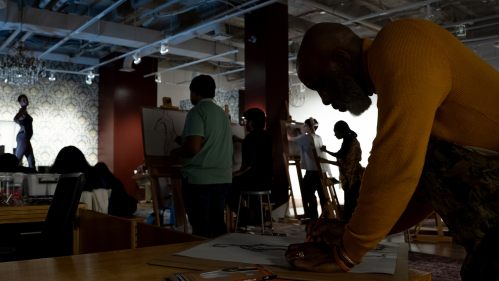
That sense of belonging is exactly what drew Newark residents like Glyvolner Gabriel into the gallery. Gabriel, 35, a tai chi and meditation coach from the South Ward, attended his first “Drawing Circle” on Jan. 29 with his sister and said it won’t be his last.
“To be in this luxurious environment felt really good. I was grounded and inspired by the open space to create,” said Gabriel, adding that he now “dabbles” in fine art. “It’s an ephemeral experience. You have to be there to really appreciate the art that was the energy of everybody in connection to the physical space.”
“Drawing Circle” was born out of a pilot community drawing class Layqa led last spring in the art building on Warren Street that attracted over 30 participants over the length of the course and ended with an open exhibition for students. This pilot program was subsidized by funding from a Rutgers Creative Catalyst Grant and made in collaboration with the BOLD Women’s Leadership Program.
As a muralist, Layqa strives to create art that can be accessed by the public while reflecting the community where it is based. He has adorned large swaths of Newark with 15 murals, including two of Rutgers alumnus Paul Robeson that flank the entrance of the Paul Robeson Main Art Gallery and a massive piece in Terminal A of the Newark Liberty International Airport that celebrates New Jersey’s diversity.
As an instructor, being able to open access to art education aligns with that ethos.
“When I told my family I wanted to do art at 18, they were supportive, but I know the realities are very different for a lot of people. A lot of my students aren’t allowed to explore anything creative because it’s not valued as much in a hyper capitalistic society,” said Layqa who was raised in Ecuador before emigrating to the United States.
“We need to exercise being human, and making art is part of being human,” he said. “I want us to have a space for that and to see this career is viable and possible.”
Sonam Salvi, a Rutgers-Newark senior majoring in fine art, is proof of that possibility. Salvi, 23, works as an intern for Layqa, assisting “Drawing Circle” participants with their easels and supplies, but she first met the instructor as a student. When she took figure drawing with Yawar a year and a half ago, she said the experience changed her as an artist.
“This class opened my view, helped me to be confident with my markings and taught me mistakes are ways to grow and learn,” said Salvi, who runs a paint-and-sip side business she hopes to grow after graduation. “It was a way to decompress and gather my thoughts. It felt sort of like a meditation.”
Now, she watches community members experience that same breakthrough on Thursday nights.
“I think artists can tap into this focus in themselves here. They get into the zone,” she said. “It’s a beautiful feeling where you feel like you can do anything, draw anything. Art always brings the community together.”