Mother-Daughter Duo Share a Rutgers Degree and Dedication to Service
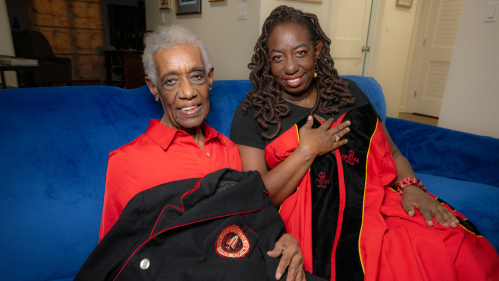
Inez Phillips Durham and her daughter Jennifer cheered each other on as they earned their doctoral degrees in psychology and joined forces professionally to change lives
Inez Phillips Durham arrived at New Jersey College for Women (Douglass Residential College) in 1953 eager to meet her new roommate.
But as the only Black student in her class, she was not paired with one.
“Nothing was put in writing, but I knew why,” said Durham, 91, who eventually roomed with “fantastic” freshman Honey Greene for her final two years. “My attitude was: if you were given a lemon, you make lemonade.”
Durham didn't just make lemonade; she laid the foundation for a lifetime of service and started a journey that would span two generations.
After graduating with a psychology degree and serving as president of Douglass College’s Class of 1957, she returned to Rutgers to earn her master’s in social work in 1961 and later a doctor of psychology from Rutgers Graduate School of Applied and Professional Psychology in 1984. Over a 50-year career as a social worker, psychologist and public school and nonprofit administrator, she became a pillar of her community.
Today, the Durham family legacy lives on at Rutgers. Daughter Jennifer Durham followed in her mom’s footsteps, graduating with the same doctoral degree from GSAPP in 1992, where she now serves as a teaching professor of school psychology and special assistant to the dean for recruitment and retention.
The path to those degrees was paved with shared sacrifice. After Inez’s husband, John, died of a heart attack in 1975, she became a single mother juggling multiple jobs – working as a psychotherapist, a school social worker, and a tennis instructor – while pursuing her doctorate.
“I did it by the grace of God,” said Inez, who credits her late husband with encouraging her to return to Rutgers for her doctorate before he died. “I prayed every day for the determination to get that degree. It wasn’t easy, but we managed. I say ‘we’ because Jennifer had to be more independent.”
The duo became a fixture at the medical science library on Busch campus, studying side-by-side on Saturdays – Inez on her dissertation and Jennifer on her high school homework. Those experiences strengthened their bond, which Jennifer likens to the "mother-sister" dynamic of Gilmore Girls. It also gave Jennifer, who at that time aspired to be a lawyer, her first up-close exposure to the mental health field.
“We had a unique relationship starting when my dad passed away. I was with her a lot,” Jennifer said. “When I had off from school, I went to work with her. She was my first role model really of what a leader was.”
In 1984, Jennifer cheered her mother on when she earned her doctorate. Less than a decade later, the roles reversed.
“Jennifer and I were the first parent-child to graduate from GSAPP. I’m very proud of that,” Inez said.
For Jennifer, her graduate school commencement was an emotional realization of her mother's "redemption story." In the late 1950s, Inez’s dreams of becoming a psychologist had been dismissed because of her race and gender. Decades later, she was not only a doctor but her daughter’s mentor.
“It sunk in how unique this was for us,” Jennifer said. “When I considered going for my master's in social work, she encouraged me go for my doctorate in psychology. It’s the best decision I ever made.”
The Durhams’ connection extends beyond the classroom. From 1995 to 2000, they worked side-by-side at the OMOLAYO Black Family Education and Development Institute, a nonprofit Jennifer founded in their hometown of Plainfield with Inez as clinical director.
Even in retirement, Inez remains a force in Plainfield. A recipient of the "Living Legacy" Award, she serves on the Public Library board of trustees, manages municipal campaigns, and still runs a youth tennis program on courts named in her honor.
For Jennifer, returning to GSAPP as a professor in 2020 was a way to plant the same seeds her mother did. Her mission as a professor is to equip students with the skills they need to reduce educational and mental health disparities among marginalized youth.
“One of our main things is service. Always, always, always give back,” Jennifer said. “That was core to who she is and she passed that on to me. That’s a big part of our family and why Rutgers resonates with her so much.”
This fall, the pair celebrated GSAPP’s 50th anniversary at a gala, reflecting on the institution that defined their careers. For Inez, the reward of working in this field isn't the titles or the awards, but the lives she helped changed – like the former client who tracked her down 50 years later this Christmas just to say thank you.
“My satisfaction comes from seeing people doing well – emotionally, socially,” said Inez. “GSAPP to me was my opportunity to make a difference. It was this amazing place to learn.”


