Former Rutgers Running Back Is Now a Champion for Students

Vaughn Calhoun was just a few months into his first year of college when his world suddenly turned upside down.
One moment, the Rutgers football running back was charging down the field; the next, he was permanently sidelined with a fractured knee. A lifetime of dedication to one goal was gone in an instant.
“Fast forward beyond the physical pain to that mental process of, ‘What is this going to look like now? What do I do now?’ Being away from home and family in California I had to figure out how to navigate this,” said Calhoun.
The first-generation college student, who graduated from Rutgers in 2003 with a degree in administration of justice, considered a career in law enforcement before pivoting to higher education. “Some college players don’t get to the ‘Now what?’ phase until spring of their senior year. I began asking those ‘What’s next?’ questions much earlier. That mental shift allowed me to start imagining life after sports.”
More than two decades later, Calhoun said the lessons he learned during that challenging period continue to inform his work guiding students as vice chancellor of student affairs at Rutgers University–Camden.
“Even for the best students, college is an adjustment,” he said. “How can we help them? How do we make the student feel seen, supported and create an environment where they can thrive?”
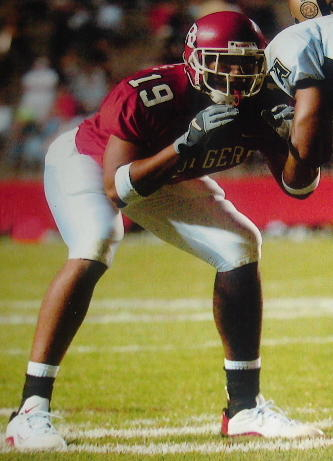
Since coming to Camden in June from Seton Hall University, where he served as associate vice president and dean for the Center of Academic Success, Calhoun said he has been focused on “creating moments” for students that enhance their Rutgers experience.
“You may not remember every class or lecture, but you remember peak moments at college. How can we be the author of those peak moments? How can we take the ordinary and make it extraordinary?” he said. “It’s just being intentional and making sure we can execute on our plans. Doing a handful of things really well instead of 1,000 mediocre things.”
That mindset inspired Calhoun and his team to send two busloads of Camden students to SHI Stadium for the Sept. 19 Blackout game against Iowa. It was the first time Rutgers-Camden and Rutgers-Newark organized transportation to a football game, making it easier for their students to cheer on the Scarlet Knights alongside their Rutgers-New Brunswick peers.
“That was tremendous. It was so successful. We are doing it again,” he said. “Those are the small moments that have lasting impact. We want more activities to make our students feel not just part of our campus but the university as a whole.”

Calhoun’s journey back to Rutgers started a few years ago, when he was invited to speak at the student athletes’ commencement ceremony. There he shared his story with the graduates and reconnected with his former coach, Greg Sciano. The move to Camden means Calhoun now shares a campus with his psychology professor wife—whom he met as an undergrad while recuperating from his football injury. The couple reside in South Jersey with their 11-year-old son.
“To me Rutgers is home. It’s where I was nurtured. This is not just a job, it has more of a purpose,” he said. “When I see those students, they were me. It’s a different campus, but we still have that Block R and are one Rutgers. It feels like I’m giving back to something that gave me so much.”
As vice chancellor of student affairs, Calhoun oversees nearly every facet of student life outside the classroom, including Residence Life, Dean of Students Office and the Wellness Center. No day is the same.
“My day can consist of a student chatting with me about their leaking shower or other pressing concerns or planning for some big on-campus event,” he said. “It really runs the gamut. I’m pulled in many different directions.”
Calhoun got his start in higher education as an assistant athletic director at Emerson College after earning his master’s degree in public policy and administration from California State University – Long Beach. As a former student athlete, it’s a role he thought he’d stick with for the duration of his career. That was until a collaboration with a professor convinced Calhoun to get out of his comfort zone and in front of the classroom. He earned a doctoral degree in education from Northeastern (Boston, MA)and taught at several universities, including the University of Maryland Global Campus, Providence College, and Becker College, before returning to New Jersey as assistant vice president of academic innovation at Rowan University, and later moving to Seton Hall.
Colleges are at a crossroads, said Calhoun. It’s a reality he finds exciting, rather than daunting, adding that his student-facing role offers daily reminders that institutions must evolve to meet the needs of the next generation.
“Students need to be college-ready but colleges need to be student-ready,” he said. “Are we ready for this generation of students who are 100% digital?”
Despite coming of age in a hyper-connected world on the verge of an AI revolution, Calhoun said college students across the country still share the same basic expectations of higher education.
“At the end of the day, students want a place where they feel they belong – where there is a purpose and a clear pathway to what’s next,” he said. “If we admit a student, they want to know, ‘If I spend time and money here, what’s the return on the back end?’ What are we going to do to make sure they are successful? This is what drives me."


